
What Is AI Coaching? A Guide for HR and People Leaders
Author: Admin
Every great performer you can name had a coach. The marathoner. The cellist. The founder who stays calm when a board meeting goes sideways. Somebody knew when to push, when to back off, and how they liked to hear the hard stuff.
Most employees never get that. Coaching has long been an executive perk, mostly because good human coaches are expensive. So companies spend real money preparing people for change, then leave them on their own right when it gets hard. That’s basically mile 20 of the marathon.
AI coaching is changing that math. You’ll hear the term a lot this year, often stuck onto products that do very different things, so here’s the quick answer first.
The short answer: AI coaching is software that gives employees and managers personalized, on-demand guidance for real work moments, like a tough 1:1, a piece of feedback or a big organizational change. The strongest AI coaching tools know how each person is wired, show up inside the apps people already use and tailor advice to everyone involved in the conversation.
What is AI Coaching?
AI coaching uses artificial intelligence to give people timely, tailored development support while they work. Think of it as a coach in your pocket. You get help in the moment: before a meeting, after a rough conversation or while you stare at an email you’re nervous to send.
Most platforms run on three building blocks:
- The input. Data about the person. Basic tools use whatever you type. Stronger ones draw on a validated assessment of personality, motivation and work styles.
- The engine. A language model that turns that context into specific guidance.
- The delivery. A chat window, or better, briefs and nudges inside Outlook, Teams, Slack and Zoom.
Here’s how it plays out. A manager has a 1:1 with Maria at 10:00. At 9:40, a short brief appears: you decide fast, Maria wants data first, so send the numbers a day ahead and agree on a decision date. She’s driven by mastery, so tie the new project to skills she wants to build. She does her best work with autonomy, so agree on the outcome and let her own the how.
That’s coaching, delivered on a Monday morning instead of once a quarter.
Heads up: vendors stretch this term to cover goal-setting bots and sales role-play tools, too. This guide focuses on coaching for managers and employees in everyday work.
Why AI coaching matters right now
The case starts with managers. Gallup finds that managers account for 70% of the variance in team engagement. Yet only 44% of managers worldwide say they’ve had any management training, per Gallup’s 2025 global workplace report. The same report found that teaching managers good coaching techniques can lift their performance by 20% to 28%.
Managers are also running on fumes. Gallup’s State of the Global Workplace 2026 shows global manager engagement fell to 22% in 2025, down from 31% in 2022. Low engagement now costs the world economy about $10 trillion in lost productivity. Still, best-practice organizations keep 79% of their managers engaged, so the gap is fixable.
Now pile on change: reorgs, acquisitions, AI redesigning roles. You’ve seen the pattern. Announce it at a town hall. Train on it in a workshop. Six months later, people drift back to old habits. A long-cited McKinsey estimate says about 70% of transformations fall short, and while researchers debate that figure, the feeling behind it rings true.
AI raises the stakes. BCG’s 10-20-70 rule says about 70% of the effort in AI adoption belongs with people and processes. Its May 2026 analysis adds that when AI initiatives fail, human factors are usually why. Support lags, too. In BCG’s AI at Work 2025 survey, only 36% of employees said their AI training was enough. And in a BCG Henderson Institute survey, 76% of executives said their people were enthusiastic about AI, while only 31% of individual contributors agreed.
Technology moves fast. People adopt it at human speed. AI coaching is built for that gap, because it reaches every person going through the change.
AI coaching vs. human coaching vs. generic AI chatbots
These three get lumped together, but each does a different job. Here’s how they compare for a mid-sized company supporting hundreds of managers.
| Human coaching | Generic AI (ChatGPT, Copilot) | Personalized AI coaching | |
|---|---|---|---|
| Who usually gets it | Senior leaders | Anyone with a license | Every manager and employee |
| When it’s available | Scheduled sessions | Anytime | Anytime, plus proactive briefs |
| What it knows about you | A lot, over time | Only what you type | Validated data on how you work |
| What it knows about the other person | Only what you share | Nothing | Their profile too |
| Cost to scale | High | Low | Low to moderate |
| Best for | High-stakes, complex leadership growth | Drafting and research | Daily people moments and behavioral change |
Take one moment three ways. A careful, detail-oriented employee needs to decide faster.
- Generic advice: “Be more decisive.” They nod and change nothing.
- Generic AI: It knows only what you type, hears one side and tends to agree with whoever’s asking.
- Personalized AI coaching: It knows everyone in the room, so the advice fits: “Share your analysis early, then commit to a decision date.”
A word of caution from the research. In a 2026 randomized trial by de Haan, Terblanche and Nowack, 114 mostly middle and senior managers got human coaching, a basic AI chatbot or nothing. Human coaching improved goal success and lowered stress. The WhatsApp-based chatbot didn’t beat the control group on most measures, and its dropout rate was about ten times higher.
The takeaway: a thin chatbot won’t cut it. Context, memory and fit carry the weight. Human coaches still matter for senior leaders in complex moments, and AI coaching brings coaching to everyone else, every day.
What makes AI coaching work
Advice only changes behavior when it fits the person. Personalization is the mechanism; adoption is the result. Three ingredients make the difference.
1. It knows how people are wired
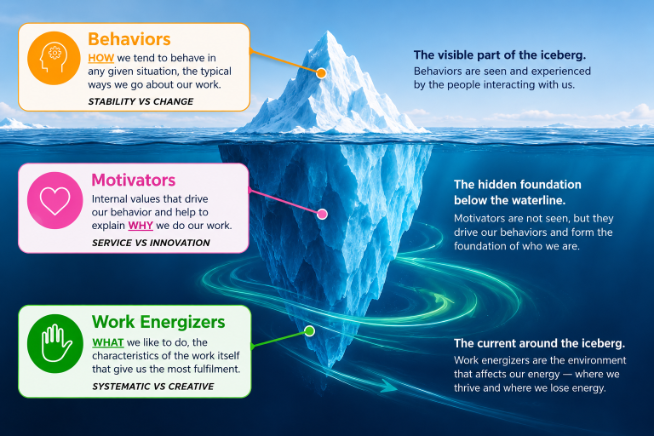
Picture an iceberg.
- Behaviors sit above the waterline: how someone communicates, decides and handles conflict. Most personality tools stop here.
- Motivators sit below it: why people do what they do.
- Work energizers are the current around it: the work and settings where someone thrives.
A quick side note on retention. Training builds competence, but motivation is what slips. Plenty of people stay capable and quietly check out. A coach that knows what drives each person helps managers keep people engaged longer.
2. It knows everyone in the room
Most hard moments at work involve two or more people: a feedback talk, a stalled handoff, two teammates who keep clashing. Coaching that sees only one side is guessing about the other.
3. It lives in the flow of work
Nobody wants another portal. Useful coaching shows up where people already work, like a brief in Outlook before a 1:1 or a quick question in Teams before a tough call.
This is the approach we’ve taken at Ask Aura. A 10-minute assessment measures behaviors, motivators and work energizers, then powers coaching inside the tools people already use, alongside Workday, SAP SuccessFactors and Microsoft Copilot. Copilot knows your documents. Ask Aura knows your people.
Where AI coaching pays off: transformation and everyday operations
Personalized coaching pays off in two places. Transformation covers reorgs, mergers, AI role redesign and new managers, where the coach reaches every affected person from day one. Operations is what comes after, when managers keep leading each person the way that works for them.
Here’s what the coach does in each moment, and what to measure:
| Moment | What the coach does | What to measure |
|---|---|---|
| Newly promoted managers | Coaches them on leading each person on their team | Time to full effectiveness |
| New process or role, including AI | Helps each employee work through the change in a way that fits them | Adoption rate |
| Reorg or acquisition | Keeps people engaged and supported through the uncertainty | Regretted attrition 6 to 12 months later |
| Everyday management | Preps managers for 1:1s, feedback and tough conversations | Team engagement and performance |
| New hires | Guides each new hire and their manager from day one | Time to productivity |
| Cross-functional work | Helps each side understand how the other works | Handoff and decision cycle time |
Agree on two or three of these before launch, so the pilot holds up at budget time.
Early results are encouraging. Fast Company, which ranked Humantelligence, the company behind Ask Aura, No. 4 in the Workplace category of its 2026 Most Innovative Companies list, reported that customers see 27% lower manager turnover than their peers.
How to evaluate an AI coaching platform
Vendor demos tend to look alike, so press on these points:
- Where its people data comes from. What users type, or a validated assessment that covers more than behavior.
- Both sides of the conversation. Prep for a 1:1 or a conflict should account for the other person.
- Assessment length. Around 10 minutes is realistic for a whole workforce. An hour isn’t.
- Where coaching shows up. Inside Outlook, Teams, Slack or Zoom. A separate app hurts adoption.
- Fit with your stack. It should sit alongside your HRIS and tools like Copilot.
- Data protection. SOC 2, GDPR and CCPA compliance, clear rules on who sees coaching conversations, and insights that support human decisions instead of automating them.
- Proof of impact. Agreed business outcomes and a focused 60 to 90 day pilot.
Also ask for usage data at week six, not just launch week. Plenty of tools spike early and fade.
AI coaching FAQ
What is AI coaching in simple terms?
AI coaching is software that gives people personalized, on-demand advice for work moments like 1:1s, feedback, conflict and change. The best tools tailor that advice to how each person works.
Is AI coaching as effective as a human coach?
Human coaches still deliver strong results for senior leaders, and a 2026 trial found they outperformed a basic chatbot. AI coaching’s edge is reach: personalized support for every employee, every day.
How is AI coaching different from ChatGPT or Copilot?
General assistants know only what you type. Personalized AI coaching draws on validated data about you, the other person and your team, so the advice fits everyone involved.
Who should use AI coaching?
Most companies start with people managers, especially newly promoted ones, since managers drive most of the difference in team engagement. Then they extend it to new hires and teams going through a reorg, merger or AI rollout.
How do you measure the ROI of AI coaching?
Pick two or three outcomes before launch, such as manager turnover, regretted attrition, time to productivity or adoption of a new process. Then compare a pilot group to a baseline.
The bottom line: a coach for every employee
Strip away the hype and the idea is simple. Give every person a coach who knows how they’re wired, and every manager gets better at the work that moves engagement, retention and performance most.
Managers stop being the bottleneck and become the multiplier. Change sticks because people get help when they need it, in a way that fits them. Everyday operations run smoother because hard conversations go a little better, week after week.
Make change stick and teams perform, one person at a time. Interested in learning more? Reach out to our team to set up a time to talk about your needs.